
iGN Biotech Private Limited
© 2026. All rights reserved.
A life beyond diabetes and insulin
dependence
Some forms of diabetes - Type 1 and Type 3C - leave the body unable to make the insulin it needs. Islet transplantation changes that: a gentle infusion of living, insulin-producing cells that take over the work the pancreas can no longer do. iGN is building the lab, the science, and the partnerships to bring this care home to India.
Managing diabetes is relentless. It doesn't have to be.
When the body can't make its own insulin, every day becomes a series of calculations - and even the best routines can't fully prevent dangerous lows or the toll that takes over a lifetime. Islet transplantation offers a different path: living cells that sense glucose and release insulin on their own, the way a healthy pancreas would. The need is greatest where the option has never existed - until now.
941,000
people living with Type 1 diabetes in India (2024)
IDF Diabetes Atlas, 11th ed. (2025)
301,000
are children & adolescents under 20
IDF Diabetes Atlas, 11th ed. (2025)
0
clinical islet isolation labs in India - until now
iGN Biotech program scope
The islet journey, end to end
A single pancreas - whether donated or the patient's own - holds hundreds of thousands of microscopic islets. The lab's work is to set them free, purify them, prove they're alive, and deliver them safely. The transplant itself is an infusion, not an operation.
Source pancreas
The pancreas - from a donor (Type 1) or the patient's own (Type 3C) - is recovered and kept in cold storage to protect the islets.
Enzymatic isolation
Collagenase enzymes gently digest the tissue, releasing the islets from the surrounding exocrine pancreas.
Purification
A density gradient separates the islets from non-endocrine tissue, concentrating the cells that actually make insulin.
Quality & culture
Islets are counted, tested for viability and glucose response, and cultured up to 48 hours before release.
Portal-vein infusion
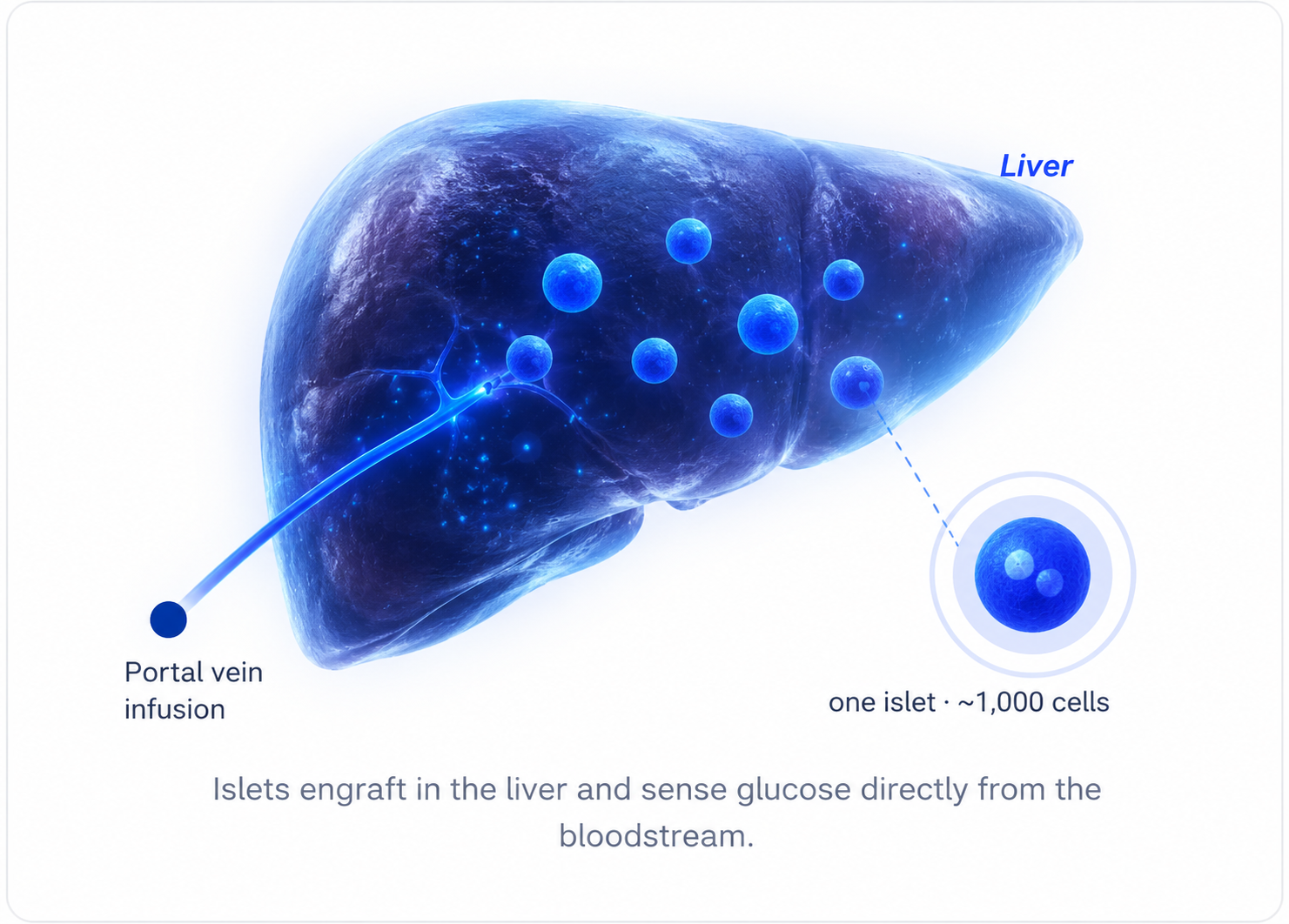
Through a thin catheter, the islets are infused into the liver's portal vein, where they engraft and begin working.
Procedure based on the Edmonton Protocol (Shapiro et al., 2000) and the CIT Consortium standards; Endotext / NIH, Islet Transplantation (updated 2025).
Why the liver?
Pancreatic islets are transplanted into the liver primarily because the liver's hepatic portal vein provides an ideal, accessible and safe environment where the cells can lodge into small blood vessels, survive and naturally secrete insulin directly into the bloodstream.
Two paths, one procedure
The same islet science helps two very different groups - and iGN's lab is built for both.
Type 1 diabetes
Donor islets · allo-transplantation
Here the immune system has destroyed the body's own islets. Healthy islets from a donor are infused to restore insulin production. Recipients take medication to protect the new cells.
Type 3C diabetes
Your own islets · auto-transplantation
When the pancreas has to be removed - often for severe chronic pancreatitis - the patient's own islets are rescued and re-infused. Because the cells are their own, no anti-rejection medication is needed.
A proven procedure, still improving
60–80%
achieve insulin independence in year 1
CITR Annual Report; Edmonton Protocol review
2023
first FDA-approved islet cell therapy (donislecel / Lantidra)
Endotext / NIH (2025)
>98%
time-in-range reported in early stem-cell-islet recipients
Frontiers in Transplantation (2025)
India's first islet isolation lab
Our goal is to bring the entire islet pipeline onshore - a GMP-grade isolation lab, validated protocols, trained teams, and a clinical program built with the Government of Tamil Nadu. We start with the proven procedure today and build toward the lab-grown supply of tomorrow.
Establish the lab & clinical program
India's first dedicated islet isolation facility, paired with a clinical transplant program with the Government of Tamil Nadu - a national first.
Standardize, train, and widen access
Sharpen isolation yields, train transplant teams, and build the systems that let more hospitals offer the procedure.
Toward stem-cell-derived & immune-evasive islets
Partner on the science that ends donor scarcity and the need for lifelong immunosuppression.
Horizon directions reflect the global research frontier; timelines depend on regulatory and clinical milestones.
Living with Type 1 or Type 3C diabetes?
If you, a patient, or someone you care for might benefit from islet transplantation, our team can help you understand the options and the next steps.